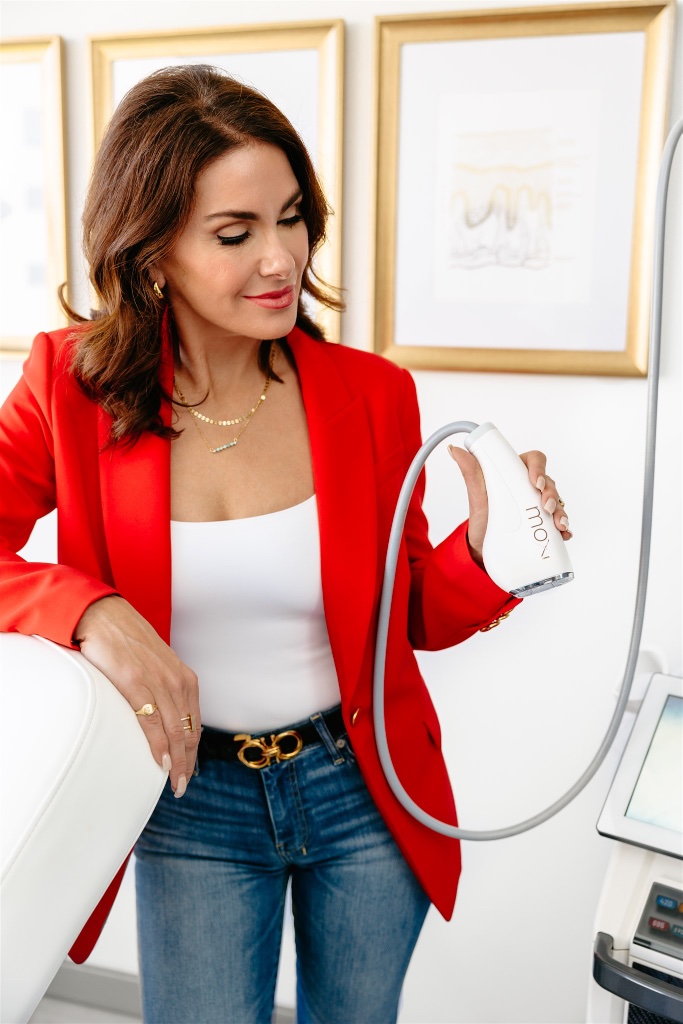
The GLP-1 to Glow Pathway: Amy Robbins on Weight Loss, Facial Volume Loss, and the Next Chapter of Aesthetic Care
Amy Robbins on how GLP-1 weight loss changes the face, why that matters, and how a thoughtful restorative plan can become the most meaningful next chapter of care.
Amy Robbins, MSNA APRN CRNA FNP-BC 18 min read May 2026Regenerative AestheticsMost patients begin a GLP-1 or medical weight-loss journey thinking about one thing: their health. Metabolic progress. A body that feels more aligned with who they are. The number on the scale, yes — but also the energy, the mobility, the confidence that comes from a meaningful, sustained commitment to change.
What many patients do not anticipate is what they see in the mirror at face level.
Not immediately. But at some point — often after 40, 50, 60 or more pounds of meaningful loss — a patient looks in the mirror and notices something different about their face. The cheeks that once felt full look a little flatter. The under-eye area is hollower than before. The transition from cheek to lower face looks a bit more pronounced. The face, overall, looks more depleted than refreshed — more tired than transformed.
This is not a failure. It is anatomy.
The face has its own system of fat compartments, structural supports, and soft-tissue architecture — and meaningful weight reduction affects those structures in very real, visible ways. Patients who come to this moment deserve a provider who can explain it clearly, honestly, and without a sales agenda. What changed. Why it happened. What the options are, if any. Whether now is even the right time to think about those options.
This article is my attempt to explain all of that — the GLP-1 to Glow Pathway as I think about it — from a provider's perspective, for patients who are navigating this exact question.
Section 01
Why the face changes
after weight loss.
The face is not a single, uniform structure. It is a layered system — bone, muscle, ligament, fat compartments, and skin — each of which contributes to the three-dimensional architecture that gives a face its characteristic shape, support, and youthfulness.
Facial fat exists in distinct compartments: deep compartments that sit close to the bone and provide foundational structural support, and more superficial compartments that give the face its softer, more youthful contours. These compartments do not behave identically during weight loss. Some deflate more readily than others. Some shift or descend as their neighboring structures lose volume. The result is not simply a "slimmer" face — it is a face whose internal scaffolding has changed in ways that are visible from the outside.
The changes patients most commonly describe include:
Midface flattening
The cheeks and upper midface lose volume, creating a flatter, less-defined appearance where there was once more fullness and projection.
Under-eye hollowing
The tear trough and lower eyelid area become more pronounced, creating a shadowed, hollow appearance that can read as tiredness even when the patient feels rested.
More visible nasolabial folds
As midface volume recedes, the structural support holding the lower face up diminishes, and the folds between the nose and mouth become more apparent.
Lower-face changes
Descent and visible softening in the jowl area, jawline, and chin may become more apparent as overall facial support reduces.
Skin laxity
Skin that was supported by underlying tissue may now appear to drape differently, particularly in patients who have experienced rapid or very significant weight reduction.
A depleted overall appearance
Even where changes are subtle, the cumulative effect can be a face that looks more fatigued, drawn, or simply less vital than the patient feels inside.
None of this is unique to GLP-1 medications. Any meaningful weight loss — whether from medication, surgery, lifestyle change, or illness — can produce similar facial changes. What makes the GLP-1 era distinct is the scale and speed at which many patients are now achieving significant weight reduction. More patients. More meaningful loss. In shorter timeframes.
Which means more patients arriving at this exact moment — looking in the mirror, feeling proud of their progress, and wondering why their face does not quite reflect how they feel.

Every facial assessment at Youthful Magnolia begins with understanding what changed — and why — before any conversation about options.
Section 02
From weight loss
to aesthetic care.
There is nothing superficial about a patient who loses 60 pounds, feels genuinely healthier and more like themselves, and then arrives at an aesthetic consultation to ask why their face looks more tired than they feel. That is not vanity. That is a person whose exterior has not yet caught up with their interior experience of transformation.
The patient who begins a medical weight-loss protocol in the spring may very naturally find themselves in a different conversation by summer or fall — not because a practice pushed them toward it, but because their anatomy led them there. A face that has lost meaningful structural support does not require an injection. But it does deserve an honest conversation with someone who knows how to evaluate it.
At Youthful Magnolia, I have watched this progression happen organically, repeatedly, over the course of my practice. A patient begins with GLP-1 weight loss support. Months later — sometimes six months, sometimes a year — they return. Not because anyone told them to. But because they looked in the mirror and thought: something changed, and I want to understand it.
That is a patient who is ready for a very different conversation. And the practices — and providers — who are prepared for that moment are the ones who will serve these patients best.
Section 03
Why this is never
a sales pitch.
I want to be direct about this: any practice that uses post-weight-loss facial changes as a funnel to sell fillers is doing something I find clinically and ethically wrong. The right conversation — the one that actually builds patient trust and produces meaningful outcomes — is not about selling. It is about seeing.
What I mean by that: a patient who has undergone significant weight loss deserves a provider who will look at their face carefully and explain, honestly, what changed. Not every patient will need treatment. Some will. Some will want to wait. Some will decide the changes do not bother them. Some will be relieved to have an explanation and nothing else. All of those outcomes are valid. None of them are a failure.
The conversation I want to have with a post-weight-loss patient is not "you need filler." It is: "Here is what I see. Here is why it happened. Here are the options, if any, that I think are worth considering for your specific anatomy and timeline. Here is what I would not recommend. And here is what I think we should do if you decide you want to do something."
That is a clinical observation. That is an educator's role. That is the kind of provider relationship that patients return to, refer people to, and trust over time.
Amy Robbins · Founder, Youthful Magnolia
"The conversation I want patients to leave with is not a treatment plan. It is clarity. Understanding what changed, why it happened, and what — if anything — they want to do about it. That clarity, by itself, is valuable. The treatment, if it comes, should follow from that."
Section 04
The GLP-1 to Glow
Pathway.
The GLP-1 to Glow Pathway is not a protocol. It is a framework — a way of thinking about the continuum of care that many patients travel, from beginning a medical weight-loss journey to eventually arriving at a conversation about what their face may need next. Here is how I think about it in stages.
Beginning
The weight-loss journey begins
A patient starts a GLP-1 protocol or structured medical weight-loss program. The focus is health: metabolic improvement, weight reduction, sustained progress. Aesthetic conversations are not yet relevant.
60–90 days in
Meaningful progress becomes visible
Weight loss is becoming apparent — in the body and, increasingly, in the face. The patient may notice early facial changes: a slightly flatter midface, a more prominent under-eye area. These changes are subtle, and the patient may not yet name them.
Weight stabilizing
Facial changes become more pronounced
As weight loss accumulates and begins to stabilize, facial changes become more visible. The patient starts asking questions — of themselves, online, sometimes to their provider — about what changed and whether there is anything to be done about it.
The conversation
An educational, personalized discussion begins
A consultation focused not on selling but on explaining. What changed anatomically. What options exist. Whether this patient's timing, anatomy, and goals make treatment appropriate now, later, or not at all.
Restoration (if appropriate)
A thoughtful, staged plan begins
For patients who decide they want to address their facial changes, a personalized, staged restoration plan is built — matched to their anatomy, their goals, and their budget. Always natural-looking. Always reversible where possible. Always honest about what treatment can and cannot deliver.
Section 05
The 7%-per-10kg heuristic —
and what it means clinically.
A clinical heuristic that I find useful in treatment planning for post-weight-loss patients is this: for roughly every 10 kilograms — approximately 22 pounds — of meaningful weight loss, there may be an approximate 7% reduction in midfacial volume. This is a clinical planning framework, not an absolute measurement, and individual variation is significant.
But as a rough orientation, it is useful. A patient who has lost 30kg — about 66 pounds — may have experienced something in the range of 20% or more of midfacial volume change. That is not a small shift. It is the kind of change that, depending on the patient's age, skin quality, and baseline anatomy, may produce noticeable structural difference.
Why does this heuristic matter? Not because I walk into a room with a calculator. It matters because it helps anchor the conversation in clinical observation rather than aesthetic opinion. When a patient says "I don't know, my face just looks different" — having a framework for why, and approximately how much, gives the conversation structure. It helps patients understand that what they are seeing is real, measurable, and explainable — not imagined, and not vanity.
It also helps with timing. A patient early in their weight-loss journey with significant additional loss ahead of them is not the right candidate for structural restoration yet. A patient who is 60 to 90 days into a stable plateau, having lost a meaningful amount, is a very different conversation.
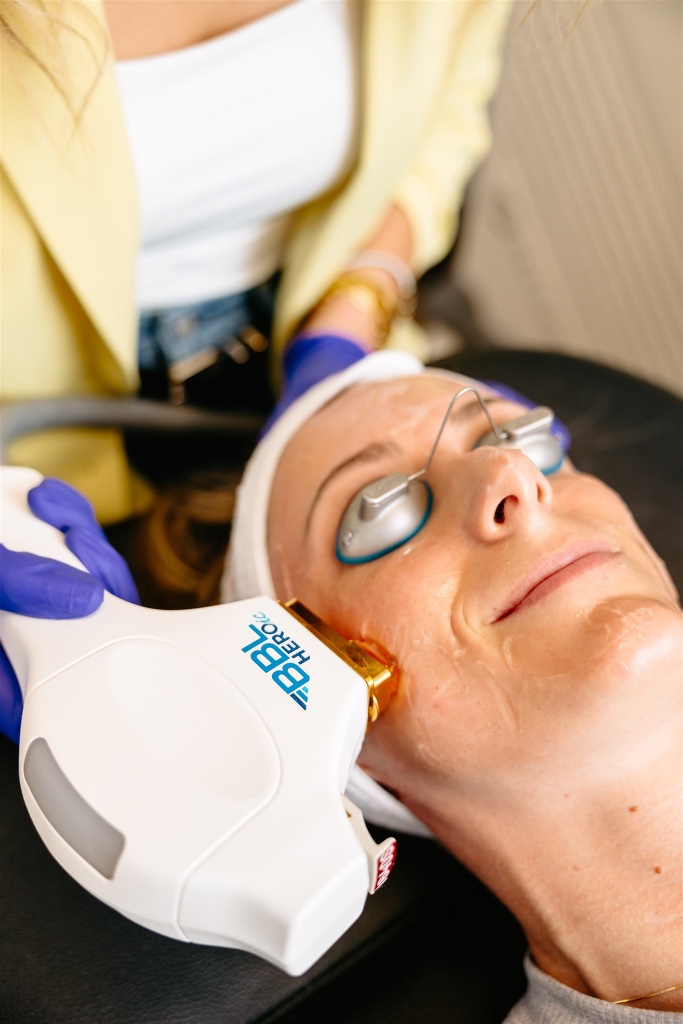
Understanding what changed is the necessary first step before any restoration conversation begins.
Section 06
What I look for in a post-weight-loss
facial assessment.
When I see a patient who has undergone significant weight loss and is coming in to talk about their face, I am not looking for a treatment to sell. I am looking at an anatomy — specifically, what changed, where, by how much, and what the underlying structure is doing.
Here is what I evaluate:
Midface support and projection
Is there visible loss in the malar region — the cheekbone area and upper midface — that is creating a flatter, less-supported appearance? How much of what the patient is seeing is volume-related versus gravitational descent?
Under-eye hollowing
How pronounced is the tear trough? Is this structural — a loss of deep fat compartment volume — or is it a skin-quality issue, or both? The answer changes which approach, if any, makes sense.
Lower-face descent and jowls
Has facial descent become more apparent as midface structural support has reduced? Lower-face changes may look like volume loss but can partly reflect the redistribution of existing tissue — a different clinical picture.
Skin quality and laxity
Separately from volume, has the skin changed in how it sits and drapes? Patients who lost weight rapidly may have skin laxity that needs its own conversation — potentially involving energy-based tightening rather than injectable restoration.
Whether weight is still actively changing
This is one of the most important data points. If a patient is still losing weight, the anatomy is still moving. Restoration that happens while the face is still changing is poorly timed. I will not recommend structural restoration in an actively shifting face.
Whether the patient is asking the right questions
Sometimes patients come in thinking they need something specific — more cheek volume, filler under the eyes — when what I actually see suggests a different priority, or a different sequence. My role is to reorient that conversation toward what I actually observe, not what a patient came in expecting to be told.
Section 07
When the right time to talk
actually is.
Timing is not a small variable in post-weight-loss facial restoration. It may be the most important one.
My general guidance: if a patient is still actively losing weight, the structural face is still evolving. Volume restoration in an actively shifting facial architecture is poorly timed — not unsafe in most cases, but likely to produce results that either do not hold as weight continues to change, or that look disproportionate once the process is further along. I tend to counsel patience in these cases — not because nothing can be done, but because the plan will be more accurate and more stable once the face has found a new resting point.
Where the conversation can start earlier — even while weight is still changing — is the observational layer. Understanding what is happening. Learning what the options are. Building familiarity with the concepts of facial restoration so that, when the time comes, the patient is not starting from zero. That early educational conversation is valuable, and I actively encourage it. It does not require a treatment plan.
The threshold I generally use for structural restoration: a patient who has been at a stable or near-stable weight for 60 to 90 days, with a weight-loss trajectory that has meaningfully slowed, is usually in a reasonable window to discuss and plan. That window can be shorter or longer depending on the individual — their total amount of loss, their rate of loss, their anatomy, and their goals.
Skin-quality treatments — things like microneedling, peptide support, or red light therapy — carry a different timing logic. They can often begin earlier because they are not placing structural volume into a face that is still actively changing. They are supporting the skin quality and resilience that will matter regardless of where the weight settles.
Section 08
What "glow" actually
means after weight loss.
"Glow" is not a clinical term. But I use it deliberately because it captures something real about what patients in this moment are actually looking for.
They are not looking to look younger. They are not looking to look different. They are looking to look like the best version of themselves — a face that matches the health, confidence, and transformation they have already achieved in the rest of their body. They want the face to feel as restored as the rest of them feels.
In practical terms, glow after weight loss might mean:
Restored support in the midface
Not overfilled. Not dramatically altered. Just enough structural restoration to bring back the support that was there before — so the face looks healthy, not heavy.
Softer under-eye transitions
The hollowness and shadowing in the under-eye area resolved — not erased, but softened — so the patient looks rested rather than depleted.
Improved skin quality and luminosity
Skin that has undergone the stress of rapid weight change — dehydration, laxity, dullness — brought back to a more vibrant, healthy-looking baseline through regenerative and quality-supportive treatments.
Natural facial harmony
A face that still looks entirely like the patient — their features, their character — just with better structural support and more vitality in the skin.
Confidence that aligns with the journey
The face no longer contradicting the progress. The exterior reflecting the interior. That is what patients are describing when they say they want to look like themselves again.
Glow is not about adding. It is about restoring harmony to a face that has already accomplished something remarkable.
Section 09
My restorative philosophy
after weight loss.
The goal after meaningful weight loss is not to overcorrect. It is not to chase every visible change. And it is absolutely not to make a patient look like they did before they lost weight — that would be both impossible and wrong.
The goal is to restore harmony. To bring the face into a more supported, more vital, more coherent relationship with itself — so that it looks healthy rather than depleted, rested rather than drawn.
My approach to restoration in these patients tends to be staged, conservative, and whole-face in its orientation. I rarely look at one isolated area. I look at the face as a structural system, consider what changed across that system, and build a plan that respects the anatomy — not the treatment menu.
Different patients will be appropriate for different paths. Some may benefit most from a hyaluronic acid filler approach — precise, reversible, immediate — targeting the midface or under-eye area specifically. Some are better suited for a Sculptra approach: a biostimulatory treatment that restores volume gradually over several months, producing results that look and feel more like tissue than filler. Some need both. Some need neither yet — they need skin quality support through PRF, regenerative treatments, or energy-based approaches that address laxity from the outside in.
And for patients with skin laxity as a primary concern — particularly in the lower face, neck, or jawline — Ultherapy or XERF may be the more appropriate primary intervention, with injectable restoration considered separately or in a later phase.
Amy Robbins · Founder, Youthful Magnolia
"The goal after weight loss is not to chase every change. It is to understand what changed, what matters, and what kind of restoration — if any — would still look like you."
Section 10
How practices should think about
this pathway.
I want to say something specifically to the providers and practices reading this — because I think many of us are underprepared for the moment we are now in.
GLP-1 medications have fundamentally shifted who is walking into aesthetic practices and what they need. A patient who began a medical weight-loss journey eight months ago and has now lost 50 pounds is not the same patient as someone who lost 10 pounds through lifestyle changes over two years. Their facial anatomy has changed differently. Their timeline is compressed. Their needs are more urgent and more specific.
Practices that want to serve this population well need to be thoughtful about a few things:
Flag GLP-1 use at every intake
A single intake question — "Are you currently on a GLP-1 or medical weight-loss protocol?" — changes the whole clinical picture for that patient. It signals to the provider that facial changes may be active or imminent, and that timing matters.
Train providers to see and explain it
Recognizing post-weight-loss facial change is a skill. Understanding how to explain it without creating fear or urgency is a different skill. Both matter. Patients who feel educated — not alarmed — are far more likely to have a productive conversation and an appropriate outcome.
Build a structured follow-up pathway
A patient who started a weight-loss protocol 60 or more days ago is approaching the window where facial changes may be worth a conversation. A follow-up check-in — framed as a next-chapter observational consultation, not a sales appointment — is good medicine and good practice.
Make it educational, not transactional
The most valuable thing a practice can offer this patient is clarity. What changed. Why. What the options are. What I would recommend, and what I would not. That conversation — even if it results in no treatment — builds a level of trust that the patient will not forget.
Think long-view, not single-session
Post-weight-loss restoration is often a multi-session, multi-phase plan. It is not a one-appointment fix. Practices that approach this with a long-view philosophy — staged treatment, appropriate timing, honest expectation-setting — will see dramatically better outcomes and dramatically stronger patient relationships.
Recognize the opportunity beyond revenue
Yes, this is an emerging opportunity in aesthetics. But the practices that capitalize on it well are the ones that are genuinely useful to these patients — not the ones that over-treat, over-sell, or treat the GLP-1 patient as a revenue segment rather than a person navigating a meaningful transition.
Section 11
Why this matters in
modern aesthetics.
We are in a new era of aesthetic medicine — one shaped in significant part by the widespread adoption of GLP-1 medications and the rapid, meaningful weight loss they are enabling for millions of patients. That era is producing a new kind of aesthetic patient: someone who did not set out to be one, who did not come in looking for filler, and who may not even know that what they are experiencing in their face has a clinical name.
The practices and providers who understand this moment — who can meet these patients with clinical clarity, educational generosity, and a thoughtful approach to what comes next — will be the ones who build the deepest and most lasting patient relationships over the next decade.
This is not primarily a revenue opportunity. It is a patient-care opportunity. The revenue is a consequence of doing the patient-care well.
At Youthful Magnolia, we approach this the same way we approach everything in our practice: with honesty, clinical depth, and a genuine commitment to what is right for the patient in front of us. The GLP-1 to Glow Pathway is not a funnel. It is a framework for being useful at the exact moment when a patient needs someone to explain what is happening to their face — and to help them figure out what, if anything, they want to do about it.

The patients who matter most are the ones navigating real transitions — and they deserve providers who take that seriously.
Common Questions
GLP-1 and facial volume loss —
answered honestly.
Why does the face change after GLP-1 weight loss?
What is facial volume loss after weight loss?
Does everyone who loses weight need filler or aesthetic treatment?
What is the GLP-1 to Glow Pathway?
When should I talk to a provider about post-weight-loss facial changes?
What treatments may help after weight-loss-related facial volume loss?
Is Sculptra a good option after GLP-1 weight loss?
Can PRF help after facial volume loss from weight loss?
Should I wait until my weight stabilizes before doing anything?
Where can I discuss post-weight-loss facial restoration in Fort Worth?
What does "glow" mean in the GLP-1 to Glow Pathway?
Related Services
GLP-1 Weight Loss Injections
Medically supervised GLP-1 programs at Youthful Magnolia.
Full Facial Balancing
Whole-face restoration designed around your anatomy, not a treatment menu.
Sculptra
Biostimulatory collagen restoration — gradual, natural-looking, long-lasting.
PRF Under Eyes
Regenerative PRF treatment for hollowed or shadowed under-eye areas.
Ultherapy
Ultrasound-based skin tightening for laxity after weight loss.
XERF Laser
Energy-based skin tightening for lower-face and neck concerns.
Weight & Body
Our full suite of weight, body, and metabolic support treatments.
Book a Consultation
Begin with a personalized evaluation from Amy Robbins.
Your Provider
Amy
Robbins
MSNA · APRN · CRNA · FNP-BC
Book a Consultation"Weight loss is a profound accomplishment. The face should reflect that — not contradict it. My job is to help patients understand what changed, and to offer a path forward that still looks entirely like them."
— Amy Robbins, Founder · Youthful Magnolia
Youthful Magnolia · Fort Worth, TX
Ready to talk about
the next chapter?
If you've experienced facial changes after GLP-1 or medical weight loss, our team can help you understand what changed, what your options are, and whether a thoughtful restorative plan makes sense for you.