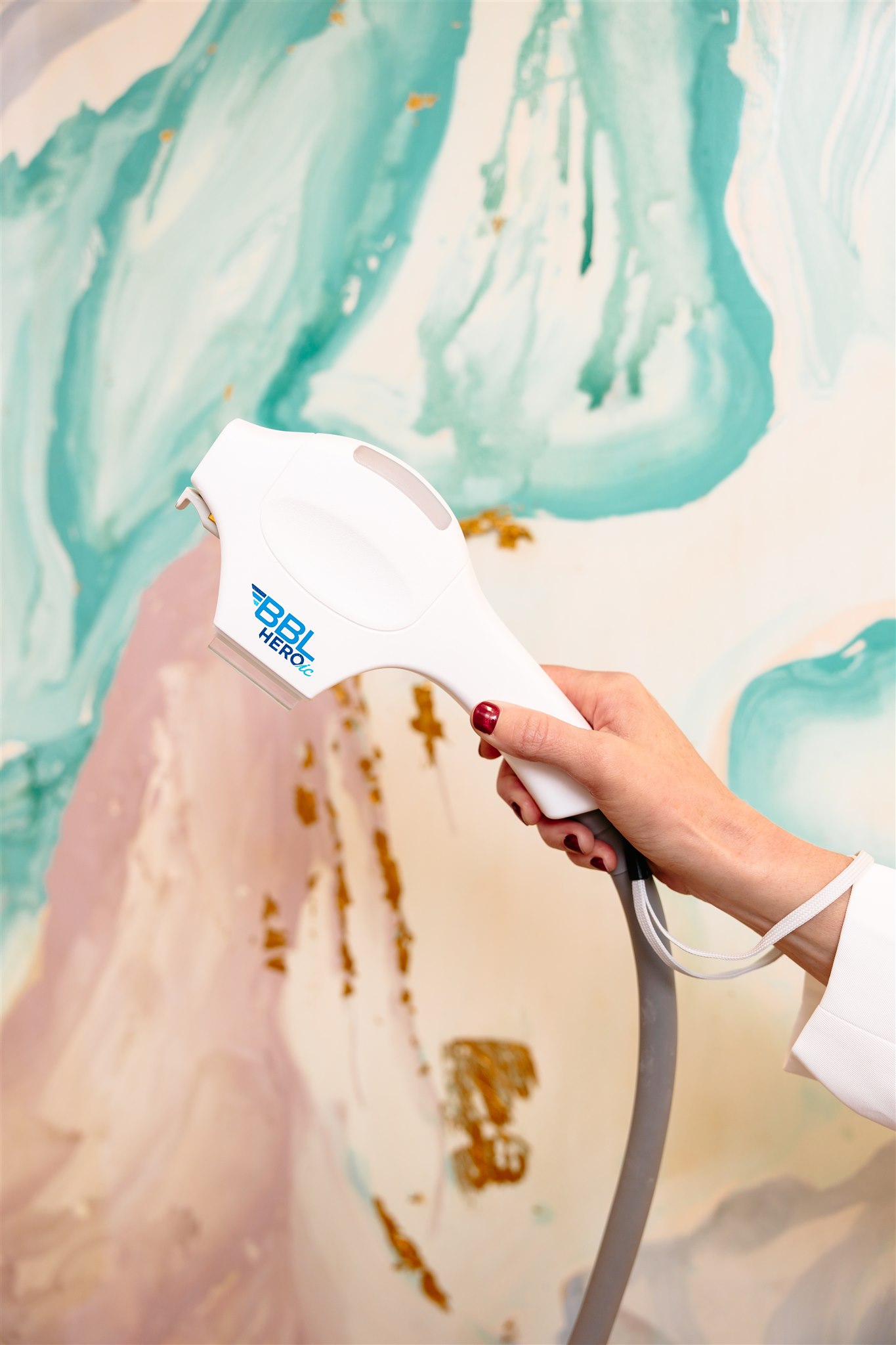
RF Skin Tightening in Fort Worth: What It Actually Treats and Why It's Different From Laser Resurfacing
A medically grounded guide to understanding what RF skin tightening actually is, what it may treat, how it differs from laser resurfacing — and why Youthful Magnolia approaches tightening as one component of a personalized plan, not a device-driven transaction.
 Amy Robbins, MSNA APRN CRNA FNP-BC 16 min read June 2026Skin Tightening
Tightening is one of the most misunderstood categories in aesthetic medicine — and one of the most valuable when it is approached honestly.
Patients come in asking about "tightening" constantly. Some have been told they need a laser. Others have been told they need surgery. Almost all of them have read something online that conflated RF tightening, laser resurfacing, ultrasound tightening, and surgical excision into one indistinguishable category — and they arrive with genuine uncertainty about what any of these things actually do.
The confusion is understandable. The aesthetic conversation is full of device names, technology categories, and marketing language that blur the lines between what these treatments are, what they treat, and what they cannot do. A patient who receives RF tightening when they actually need resurfacing — or resurfacing when they actually need tightening — will be disappointed not because the treatment failed, but because the wrong tool was chosen for the wrong problem.
At Youthful Magnolia in Fort Worth, we approach tightening as one component of a comprehensive non-surgical rejuvenation plan — built around the anatomy in front of us, not around the device most recently added to the market. This article explains what RF skin tightening actually is, what it may treat, how it differs from laser resurfacing, and when tightening makes more sense than surface renewal.
Section 01
What RF skin tightening
actually is.
RF (radiofrequency) skin tightening is a non-surgical treatment that delivers controlled thermal energy into the dermis and subdermal tissue using radiofrequency waves. Unlike laser energy — which uses light to target specific chromophores (pigment, water) in the skin — RF energy generates heat through the electrical resistance of tissue as the radiofrequency waves pass through it. This heat is what produces the tightening effect.
The mechanism is clinically elegant: controlled thermal injury to the dermis triggers the skin's natural wound-healing response. Existing collagen fibers contract immediately (producing some visible tightening right away), and new collagen production is stimulated over the following weeks and months (producing the gradual, progressive tightening that characterizes the full result). The effect is structural — it addresses the firmness and support of the skin, not its surface character.
What this means in practice: RF tightening is the right tool when the concern is laxity, looseness, or loss of structural support. It is not the right tool when the concern is surface texture, pigmentation, pore quality, or fine lines at rest — those are surface-quality concerns that belong to the resurfacing category. Understanding this distinction is the foundation of any productive tightening conversation.
The Two Effects of RF Energy
Immediate collagen contraction
Existing collagen fibers in the dermis contract in response to the thermal energy — producing a visible tightening effect that is noticeable immediately after treatment, though the full effect takes weeks to mature.
Progressive collagen neogenesis
The thermal injury triggers fibroblast activity that produces new collagen and elastin over 3–6 months — the progressive, gradual tightening that characterizes the full result and distinguishes RF tightening from a one-time surface treatment.
Section 02
What RF skin tightening
may treat.
The areas where RF tightening tends to be most relevant — and the concerns it may meaningfully address for appropriate candidates.
Face
Concerns
Early laxity, jawline softening, lower-face descent, mild cheek laxity, perioral looseness
How RF may help
Collagen contraction and neogenesis in the dermis and subdermal layers supports tighter, more structurally defined facial contours — particularly along the jawline and lower face, where early laxity tends to appear first.
Neck
Concerns
Horizontal neck lines, submental laxity, early turkey-neck appearance, neck-band prominence
How RF may help
The neck is one of the most responsive areas to RF tightening — thin skin with limited subcutaneous fat responds well to thermal collagen contraction, producing meaningful improvement in tone and visible firmness for appropriate candidates.
Lower face & jowls
Concerns
Early jowl formation, jawline definition loss, pre-jowl softening, marionette region looseness
How RF may help
For patients with early jowl formation where surgical excision is not yet warranted, RF-based tightening can delay or reduce the appearance of jowling by improving the structural support of the overlying skin and superficial tissue.
Body
Concerns
Post-weight-loss skin softness, abdominal laxity, arm and thigh looseness, contour irregularities
How RF may help
Body RF tightening addresses mild to moderate skin laxity in larger surface areas — supporting contour and tone following weight loss, aging, or pregnancy in patients who do not require surgical excision.
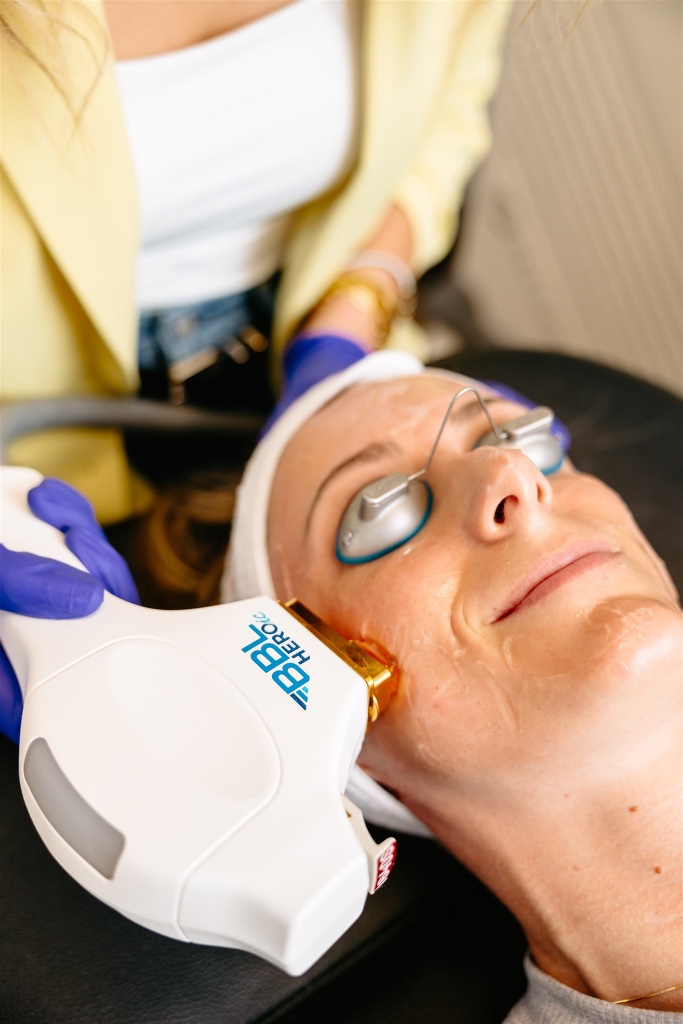
The lower face and neck are among the most responsive areas to RF tightening — and the areas where resurfacing alone produces the least visible structural change.
Section 03
RF tightening vs laser resurfacing —
the comparison that matters.
Two technologies, two different mechanisms, two different targets. Understanding the distinction is the foundation of choosing the right tool.
Tightening vs Resurfacing — Two Different Targets
RF Tightening
Structural layer
Thermal energy delivered into the deep dermis and subdermal tissue — where firmness and structural support live.
Laser Resurfacing
Surface layer
Light energy removes or remodels the skin surface — where texture, tone, and pigmentation live.
Primary mechanism
RF Tightening
Delivers radiofrequency thermal energy into the dermis and subdermal tissue to produce controlled collagen contraction and neogenesis — the structural tightening effect.
Laser Resurfacing
Removes or remodels skin layers through light-based energy — ablative lasers remove the outer skin surface, non-ablative lasers stimulate collagen through controlled thermal injury without surface removal.
What it addresses
RF Tightening
Skin laxity, soft tissue looseness, contour support, structural tightening. Targets the "tightening" component of aging — where skin and superficial tissue have lost their firmness.
Laser Resurfacing
Surface texture, tone, pigmentation, pore quality, fine lines, sun damage. Targets the "surface quality" component of aging — where the visible character of the skin itself has changed.
Depth of action
RF Tightening
Can reach the deep dermis and subdermal layers — the structural layer where collagen and elastin provide skin its firmness and support. Depth varies by platform and applicator.
Laser Resurfacing
Ablative lasers act at the surface and upper dermis; non-ablative fractional lasers reach the mid-dermis. Resurfacing depth is typically shallower than RF tightening depth.
Visible result character
RF Tightening
Tighter, more supported, more structurally defined — the skin looks firmer and more lifted. Changes develop gradually as collagen remodels over months.
Laser Resurfacing
Smoother, more even, more refined — the skin looks renewed at the surface. Texture and tone improve; firmness is a secondary benefit, not the primary target.
Downtime profile
RF Tightening
Minimal to moderate — most RF tightening treatments produce redness and mild swelling for hours to days, with minimal visible surface recovery. Some deeper RF platforms involve longer recovery.
Laser Resurfacing
Varies significantly — non-ablative lasers like MOXI involve minimal downtime; ablative resurfacing like HALO or ProFractional involves 5–10 days of visible healing.
Role in a treatment plan
RF Tightening
Addresses the structural component of aging — skin that has lost firmness and support. Often combined with injectables and resurfacing in a comprehensive plan.
Laser Resurfacing
Addresses the surface component of aging — skin that has lost quality and character. Often combined with tightening and injectables in a comprehensive plan.

Lasers renew the surface. RF tightens the structure. The right plan often uses both — sequenced around the patient's anatomy and goals.
Section 04
Amy Robbins on tightening —
what she wants patients to understand.
Tightening is one of the categories where I see the most misunderstanding — and where a thoughtful consultation produces the most meaningful difference in outcome. Patients come in convinced they need a laser, when what they actually need is tightening. Or they've been told they need surgery, when RF-based tightening would produce a meaningful improvement without the surgical commitment.
The first thing I evaluate in any tightening conversation is: is the primary concern actually laxity? If the skin has lost firmness, developed early jowling, or feels structurally "loose" — then tightening is the right category. If the concern is texture, pigmentation, pore quality, or surface lines at rest — then resurfacing is the right category. These are not interchangeable. A patient who receives tightening when they need resurfacing will see no improvement in their actual concern — and vice versa.
The second thing I evaluate is the degree of laxity. RF tightening is most effective for patients with early to moderate laxity — before the structural change has reached the threshold where surgical excision is the only tool that can produce the desired correction. For patients with significant laxity, I am honest: non-surgical tightening has limits, and surgical consultation may be the more appropriate path. Pretending otherwise does not serve the patient.
What I want patients to take from this: tightening is one tool among several in a comprehensive rejuvenation plan. It is often the right tool — but it is never the only tool, and it is never the right answer to a question it doesn't actually address. The consultation exists to identify what the actual concern is, and match the treatment to it.
"Tightening and resurfacing are not competing technologies — they are complementary tools that address different components of aging. The patient who understands this makes better decisions than the patient who chases a device name."
Amy Robbins
MSNA · APRN · CRNA · FNP-BC · Founder, Youthful Magnolia
Section 05
When tightening may make more sense
than resurfacing.
The clinical scenarios where RF-based tightening is the more appropriate starting point.
The primary concern is laxity, not surface quality
When skin has lost firmness, developed early jowling, or feels "loose" — but the surface quality (tone, texture, pigmentation) is not the dominant complaint — tightening is more relevant than resurfacing.
Early jowl formation before surgical threshold
Patients with early jowling whose structural change has not yet reached the level where surgical excision is warranted may benefit meaningfully from RF tightening support.
Neck laxity and horizontal lines
The neck is one of the most responsive areas to RF tightening — and one of the areas where resurfacing alone produces the least visible structural improvement.
Post-weight-loss skin softness
Patients who have lost significant weight and are left with mild to moderate skin laxity — but not enough excess skin to justify surgical excision — may benefit from body RF tightening.
Patients not ready for surgery
For patients who want to explore non-surgical options before considering surgical intervention — or who are not candidates for surgery — RF tightening represents a meaningful non-surgical pathway.
Maintenance of prior surgical results
Patients who have had surgical procedures in the past may use RF tightening as part of a maintenance strategy to prolong results and address new laxity as it develops.
The right tool depends on what is actually happening in the skin — not on what is most recently trending.
Section 06
When newer RF-based platforms
may enter the conversation.
The RF tightening category has expanded significantly in recent years. What began as a relatively limited set of monopolar and bipolar platforms has grown into a diverse ecosystem of technologies — including RF microneedling (which delivers energy through insulated needles at controlled dermal depths), fractional RF, and platforms that combine RF with other energy modalities for more comprehensive tissue remodeling.
For some patients — particularly those with more complex presentations involving both surface texture and structural laxity, or those who have had incomplete response to surface-level treatments — newer RF tightening technologies may become part of the conversation during consultation. These advanced RF-based platforms can deliver energy at specific depths, combine thermal collagen contraction with mechanical remodeling, and address concerns that earlier tightening platforms could not.
At Youthful Magnolia, our treatment platform continues to evolve based on patient needs and anatomy. Advanced RF-based platforms may be discussed during consultation when they are clinically appropriate for the individual presentation — not because they are newer, but because they may genuinely serve the patient's goals better than the alternatives. These are conversations that happen after we understand the skin in front of us, not before.
What does not change as the technology evolves: the fundamental principle that the treatment must match the concern. A newer RF platform applied to a patient who actually needs resurfacing — or a resurfacing laser applied to a patient who actually needs tightening — produces the same disappointing result regardless of how advanced the technology is. Device capability matters. Provider thinking matters more.
Section 07
What a consultation at Youthful Magnolia
may include.
Every tightening evaluation begins with direct assessment — not with a device recommendation.
Laxity assessment and anatomical evaluation
Amy evaluates the degree and distribution of skin laxity — face, neck, lower face, jowls — and distinguishes between laxity that may respond to non-surgical tightening and laxity that has reached the threshold for surgical consideration.
Component separation: laxity vs surface quality
Is the primary concern actually tightening, or is there a significant surface-quality component that would be better served by resurfacing? Many patients have both — and the plan must address each appropriately.
Treatment category selection
Based on the evaluation, Amy recommends the appropriate treatment category — RF tightening, laser resurfacing, ultrasound tightening, injectables, or a combination — and explains why each may or may not fit this specific presentation.
Realistic timeline and expectations
RF tightening results develop gradually over months, not days. Amy explains what the timeline looks like — when to expect initial contraction, when to expect progressive improvement, and what maintenance may involve.
Combination planning where appropriate
For patients whose concerns span tightening and surface quality, Amy may recommend a sequenced plan combining RF tightening with resurfacing, injectables, or other modalities — in the right order and with appropriate intervals.
Honest limits conversation
If the degree of laxity has exceeded what non-surgical tightening can meaningfully address, Amy says so — and refers to a trusted surgical colleague rather than over-promising what non-surgical tools can deliver.
Amy evaluates every tightening patient personally — no delegated assessments
Honest distinction between laxity and surface quality as the primary concern
Treatment matched to anatomy — not to device popularity
Honest about limits — surgical referral when non-surgical tools are insufficient
Treatment platform that continues to evolve with patient needs
Combination planning — tightening, resurfacing, and injectables sequenced appropriately
Realistic timeline expectations — results develop over months, not appointments
Premium boutique experience in Fort Worth's most intentional aesthetics practice
Common Questions
RF skin tightening —
answered honestly.
What is RF skin tightening?
How is RF skin tightening different from laser resurfacing?
What areas can RF skin tightening treat?
Does RF skin tightening hurt?
How long do RF tightening results last?
How many RF tightening sessions will I need?
Is RF skin tightening safe for all skin types?
Can RF tightening replace a surgical facelift?
What is the difference between RF tightening and RF microneedling?
Where can I learn about RF skin tightening in Fort Worth?
Related Services
Laser Treatments
The full Sciton-based laser platform — for the resurfacing side of the tightening vs resurfacing conversation.
XERF Laser
Advanced resurfacing and skin-renewal laser — for patients whose concerns span tightening and surface quality.
Ultherapy
Ultrasound-based tightening — an alternative energy modality for structural tightening of the face, neck, and body.
Weight & Body
Body-focused treatments including tightening, contour support, and post-weight-loss skin quality.
Full Facial Balancing
Injectable-based structural support — often combined with tightening in a comprehensive facial plan.
Book a Consultation
A direct evaluation by Amy Robbins — always the right first step for a tightening conversation.
Related Articles
Your Provider
Amy
Robbins
MSNA · APRN · CRNA · FNP-BC
Book a Consultation"Tightening is not the answer to every aging concern — but when it is the right answer, it produces meaningful, lasting improvement that no surface treatment can replicate. The consultation exists to find that distinction."
— Amy Robbins, Founder · Youthful Magnolia
Youthful Magnolia · Fort Worth, TX
Ready to understand whether
tightening is right for you?
If you've been wondering whether RF skin tightening is the right path — or whether your concern is better served by resurfacing, injectables, or a combination — a personalized evaluation is the right first step. Amy Robbins assesses every tightening patient personally and builds the plan around what she actually observes.