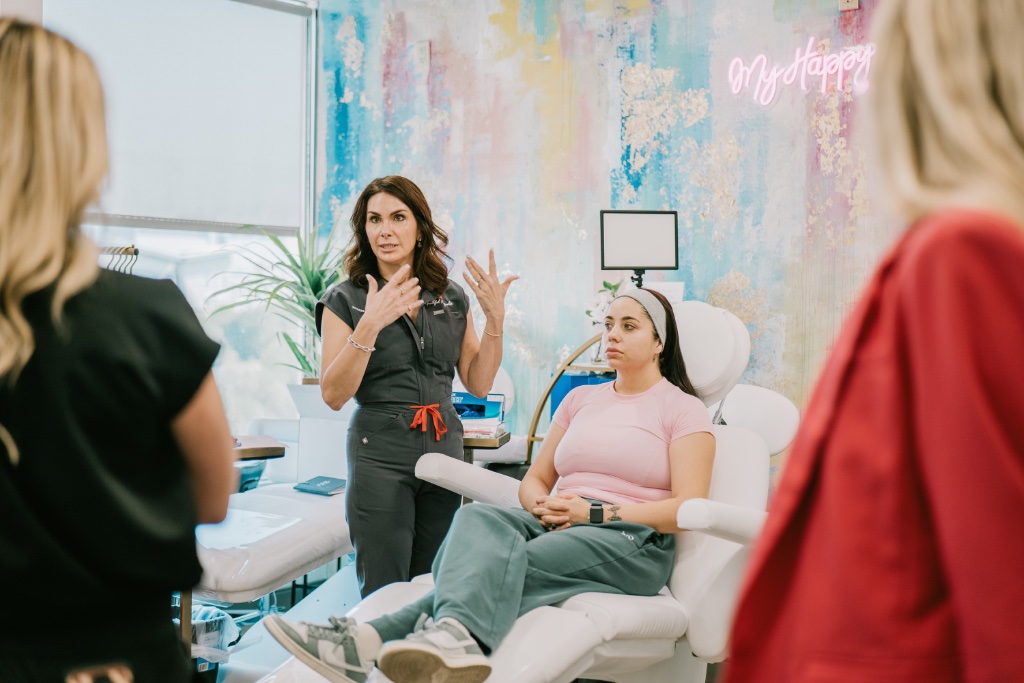
When Weight Loss Changes the Face
Amy Robbins on why significant weight loss can change the face, how to think about facial volume loss with more clarity, and what natural restoration may look like when the time is right.
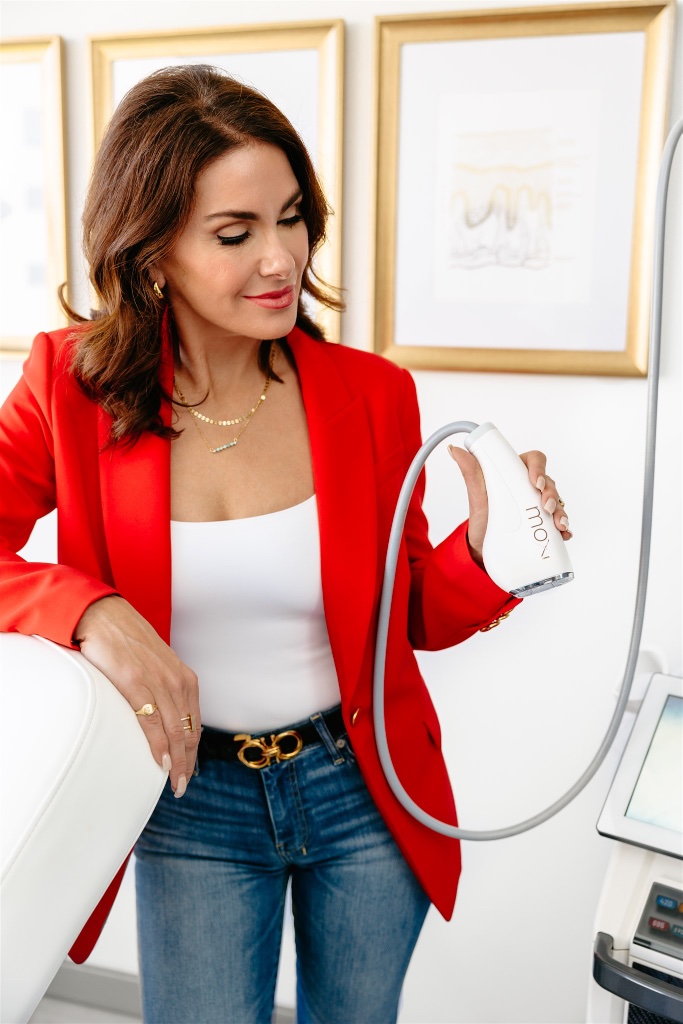 Amy Robbins, MSNA APRN CRNA FNP-BC 19 min read May 2026Regenerative Aesthetics
One of the most surprising things about meaningful weight loss is how quickly the face can tell the story before the patient is ready to hear it.
A patient will come into my practice and describe a transformation that is, by any standard, remarkable. They feel stronger. They move more easily. Their labs are better. Their relationship with their body has fundamentally shifted. The weight they have carried — in every sense — has started to come off, and the relief is real.
And then they will say something like: "But when I look in the mirror, something about my face is different. I can't quite name it. I look older. Or more tired. Or just — less like myself."
That is not vanity. That is anatomy. Meaningful weight loss changes the body, and the face is part of that body. When facial fat compartments lose volume — the same fat compartments that give the face its structure, its softness, its youthful support — what remains is a face that may look thinner but also more depleted, more shadowed, more fatigued.
What that patient needs is not a sales pitch. It is an explanation. A real one. From someone who can look at their face, describe what changed, and then have the restraint to let them decide what, if anything, they want to do about it.
This article is that explanation. Written from my own perspective, for any patient who has walked this road — or is about to — and wants to understand what is happening from the neck up.
Section 01
Why patients sometimes feel healthier but look more tired.
This is the tension that so many patients struggle to articulate — and that too few providers take seriously.
A patient who has lost 40, 60, 80 pounds feels, by every internal measure, better. Their energy is different. Their confidence is different. The way they move through the world has changed. And yet, something about their reflection does not match that internal experience. The face in the mirror looks depleted. Under-eye hollows are more visible. The cheeks appear flatter. The transition from eyelid to cheek, from cheek to jawline, from jawline to neck — all of it has shifted, subtly or not.
For many patients, this disconnect is genuinely disorienting. They have done the hardest thing — committed to their health, sustained the discipline, earned the results. And the face seems to have moved in a different direction.
What I want patients to understand is that this is not a contradiction. It is two parallel processes that happen to produce an uncomfortable mismatch. The body loses fat broadly. The face loses its structural fat specifically. The body looks trimmer. The face looks more hollow. Both are real. Neither cancels the other out. And acknowledging the tension — rather than dismissing it as cosmetic anxiety — is the first step toward a genuinely useful conversation.
Amy Robbins · Founder, Youthful Magnolia
"You should never feel apologetic for noticing what your face looks like. If you feel healthier but look more tired, that is a real observation — and it deserves a real explanation, not a brush-off."
Section 02
What actually changes in the face during significant weight loss.
The face is not a single plane. It is a layered, three-dimensional system — bone, deep fat compartments, ligaments, superficial fat, muscle, and skin — all working in concert to create the architecture we recognize as "the face." When a patient loses meaningful body weight, several of those layers are affected in ways that change the visible appearance from the outside.
Here is what I most commonly observe in patients after significant weight loss:
Midface volume reduction
The malar fat pads — the structures that give cheeks their fullness and create the convex, youthful shape of the midface — deflate. The face appears flatter, less dimensional, and structurally less supported.
Under-eye hollowing and shadowing
As the deep medial cheek fat pad reduces, the tear trough becomes more concave. Shadows form beneath the eyes. The patient looks more tired, more drawn — even when they feel rested.
Nasolabial fold deepening
The folds between the nose and mouth become more prominent as the midface loses the volume that was holding the lower face in a lifted position. This is often perceived as aging, but it is primarily a volume-driven structural change.
Temple hollowing
The temporal fat pad, one of the more subtle facial fat compartments, can reduce significantly — creating a hollowed, more skeletal appearance at the temples that contributes to an overall sense of facial depletion.
Lower-face and jawline changes
As overall facial support reduces, the lower face may appear softer, heavier, or more descended. Jowling — visible tissue along the jawline — may become more apparent, not because of weight gain but because the internal scaffolding has shifted.
Skin laxity
Skin that was supported by underlying fat and tissue may now drape differently — particularly in patients who experienced rapid or very significant weight reduction. This is especially visible along the jawline, neck, and lower face.
The specific pattern of change varies significantly from patient to patient — depending on the amount of weight lost, the speed of loss, baseline anatomy, age, skin quality, and genetics. Two patients who each lost 50 pounds may present with very different facial patterns. That individual variation is precisely why a protocol-based approach is the wrong answer and a personalized evaluation is the right one.

Every evaluation begins with understanding the specific pattern of change — not applying a generic assumption about what weight loss does to the face.
Section 03
Why GLP-1-related weight loss can make facial changes more noticeable.
Nothing about GLP-1 medications targets the face specifically. The face changes because the body changes. What distinguishes the GLP-1 era from previous weight-loss patterns is pace and magnitude.
Patients on GLP-1 protocols such as semaglutide or tirzepatide are frequently achieving 15%, 20%, even 25% or more of total body weight reduction — and they are achieving it within months rather than years. That speed and scope mean the facial fat compartments are reducing more quickly and more completely than in a slow, gradual lifestyle-based trajectory. The result is facial change that can appear more sudden, more pronounced, and more difficult for the patient to process in real time.
Patients may notice their face changing before they have the language to describe it. They may search online and encounter terms like "Ozempic face" — a phrase I find reductive and unhelpful, because it frames a normal anatomical consequence as a side effect or failure of a medication that is, for many patients, genuinely transformative.
This is not something going wrong. It is the face changing alongside the body. The patient deserves to know that what they are seeing is real, is explainable, is neither their fault nor their imagination — and that there are thoughtful options available when and if the time is right.
Section 04
Why this conversation deserves more sensitivity and less sales pressure.
I want to say something directly: any practice that treats post-weight-loss facial change as a marketing funnel is missing the point of what these patients actually need.
A patient who has spent months — sometimes years — working to change their health is not walking into a consultation looking for a sales pitch. They are looking for someone who sees them. Who can look at their face with clinical knowledge and explain, honestly, what happened. Who can tell them what the options are without overselling. Who can tell them if waiting is the better choice without feeling like they have failed to close a deal.
The aesthetic industry has a complicated relationship with GLP-1-related facial change because it represents a real, growing patient population — and where there is patient demand, there is commercial opportunity. But the practices that build lasting trust with these patients will be the ones that lead with education and patience, not urgency and conversion.
My approach is simple: explain first. Recommend second. And only recommend what I would genuinely want for the patient if they were someone I cared about — because they are.
Amy Robbins · Founder, Youthful Magnolia
"Not every patient who sits in my chair needs a treatment plan. Some need clarity. Some need permission to wait. Some need someone to say: what you are seeing is real, and it is okay to take your time deciding what to do about it."
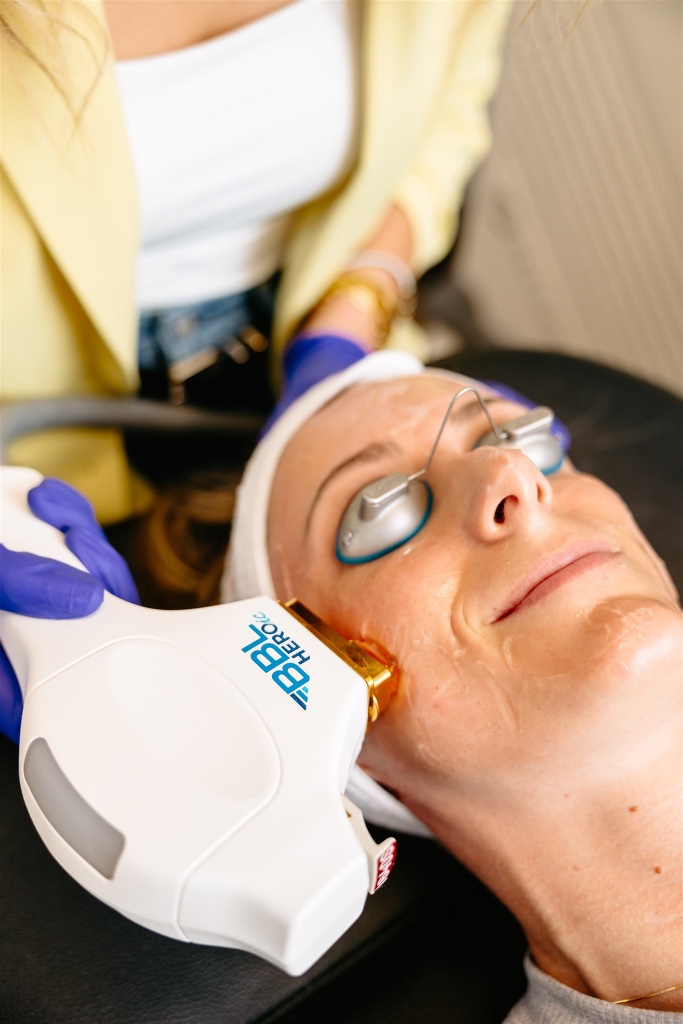
The best first conversation is often the one where the patient leaves with understanding — not a treatment plan.
Section 05
What natural restoration can mean after weight loss.
Natural restoration does not mean undoing all visible change. That is neither possible nor desirable. A patient who has lost 60 pounds has a different face than they had before — and that face is not wrong. It is different. Restoration is about choosing, thoughtfully, which differences to address and which to accept.
In my practice, natural restoration after weight loss typically means:
Restoring structural support where it matters most
Not filling every hollow. Not chasing every shadow. Identifying the one or two structural changes that are most responsible for the depleted appearance and addressing those — so the face looks supported without looking heavy.
Prioritizing harmony over volume
A face that looks natural after restoration is one where the proportions are balanced — where the midface supports the lower face, where the under-eyes transition softly into the cheek, where the jawline has definition without tension. That is a design question, not just a volume question.
Staging treatment over time
A staged approach allows the face to settle between interventions, gives the provider a chance to evaluate each step, and creates a result that evolves naturally rather than arriving all at once. This is how the best outcomes happen.
Preserving identity
The patient should look like themselves — not a version of themselves that a treatment plan decided. Natural restoration honors the patient's features, character, and the progress they have already made.
Knowing when enough is enough
One of the hardest things in restorative aesthetics is stopping. The temptation is always to do a little more. The best results are the ones that left something undone — where the final outcome feels effortless because the provider chose restraint over addition.
Section 06
My philosophy on restoration after weight loss.
When a patient sits across from me after meaningful weight loss, they are trusting me with something more nuanced than most people realize. They are not just asking for a treatment. They are asking whether the gap between how they feel and how they look can be closed — and whether that closing can happen without making them look like someone else.
My philosophy is built on a few principles that I hold without compromise:
The goal is never to reverse the weight loss visually. That patient earned their progress. The face should reflect health and vitality — not restore the appearance of a heavier face. Restoration is about support, not replacement.
A thoughtful plan produces better outcomes than an aggressive one. I almost always prefer to do less in the first session and reassess. The face reveals itself differently after an initial intervention, and the second step is always smarter than it would have been without seeing the first result.
Not every area needs treatment. Patients often come in with a list of things they have noticed. My role is to identify which of those observations reflect changes that are worth addressing and which are normal variations of a thinner, lighter face. The answer is rarely "everything."
Natural-looking results require anatomical thinking, not product thinking. I am not thinking about which filler to use first. I am thinking about the architecture — where the support needs to exist so that the overlying tissue sits naturally. The product is a tool. The plan is the treatment.
"When weight loss changes the face, my job is not to sell a solution. It is to explain what changed, help the patient decide what matters to them, and build the most natural plan possible — if they want one at all."
Amy Robbins
Founder · Youthful Magnolia
Section 07
What I evaluate during a post-weight-loss facial consult.
When I sit down with a patient who has lost meaningful weight, I am not looking for reasons to treat. I am mapping a face. Specifically, I am assessing what has changed relative to the structural system that holds everything together — and determining whether what I observe is stable, still evolving, or ready for intervention.
Midface support and convexity
Has the cheek area lost the convex shape that gives the face its dimensional, youthful appearance? How much projection is gone, and where is the deepest deficit — laterally, centrally, or both?
Under-eye and tear trough depth
Is the tear trough more pronounced? Is the hollow deep and structural, or relatively mild? Is the skin quality in the area contributing to the shadowed appearance, or is it primarily a volume deficit?
Nasolabial and marionette changes
Are the folds more visible because midface volume receded, because the tissue has descended, or both? This distinction matters because the treatment for each is different.
Jawline definition and lower-face heaviness
Has jowling become more apparent? Is the jawline less defined? Is this a volume issue, a laxity issue, or a combination — and does it require tightening, volumization, or watchful waiting?
Skin quality and elasticity
Has the skin changed in its drape, texture, or resilience? Is there laxity that needs its own conversation — potentially involving energy-based tightening rather than injectable work?
Whether weight is still in motion
If the patient is still actively losing, the anatomy is still moving. I will not place structural restoration in a face that has not yet found its new baseline. This is one of the most important assessments I make, and one I will not compromise on.
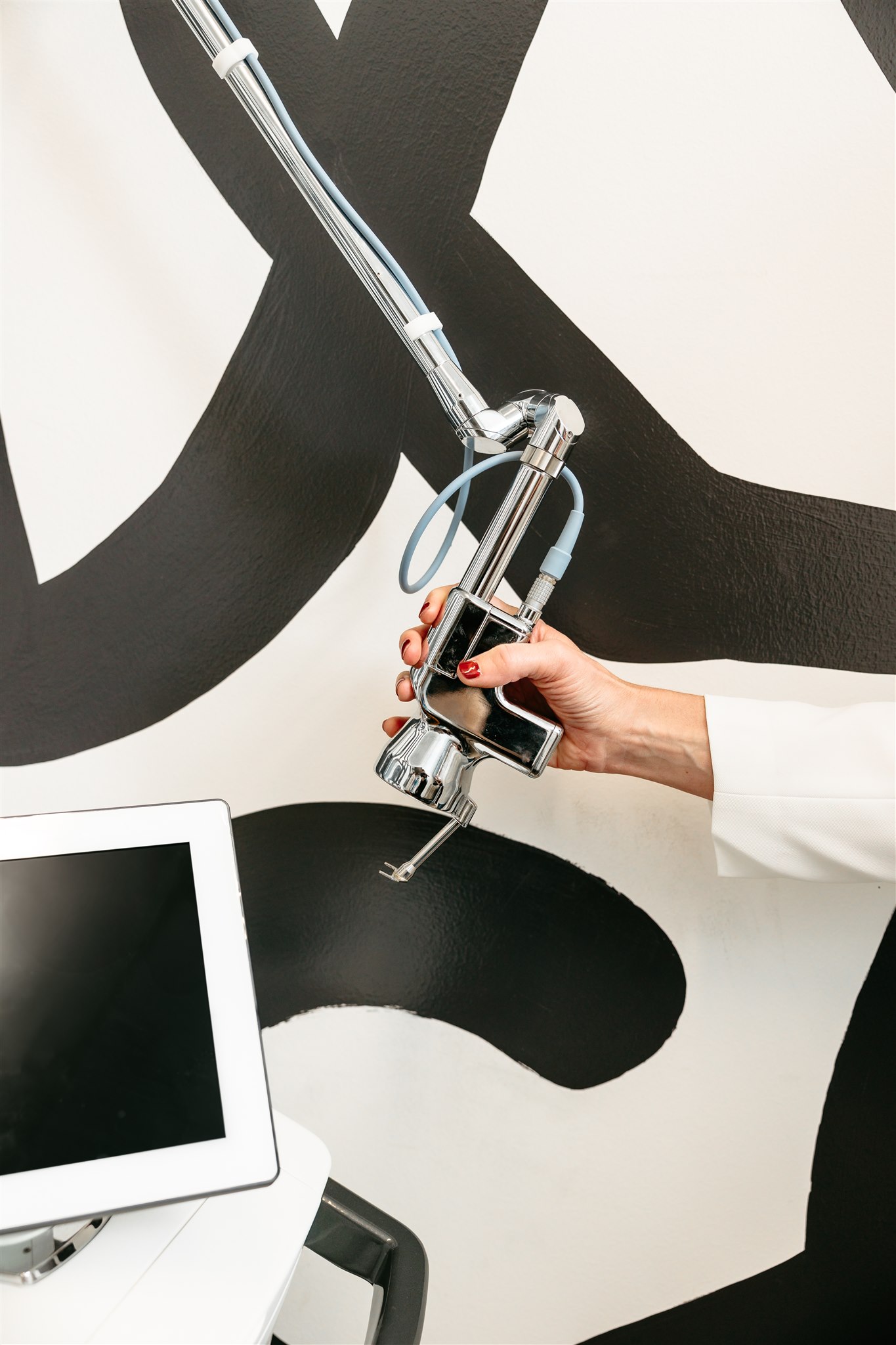
Every consultation starts with understanding the face as a system — not as a collection of individual treatment areas.
Section 08
When to wait, when to watch, and when to consider restoration.
Timing is not a footnote in post-weight-loss restoration. It may be the most consequential variable in the entire process.
I think about timing in three categories:
Active weight loss is ongoing
If the patient is still losing weight meaningfully, I generally advise against structural facial restoration. The anatomy is still changing, and treatment performed now may not remain accurate as the face continues to evolve. This is the time for education and observation — building understanding, not a treatment plan.
Weight is slowing but not yet stable
As the rate of loss declines and the patient approaches a more stable plateau, the conversation begins to shift. Skin-quality treatments — microneedling, peptide support, red light therapy — may be appropriate here because they do not place structural volume into a still-moving face. The observational consultation becomes more specific.
Weight has stabilized for 60–90 days
Once a patient has been at a relatively consistent weight for two to three months, and the trajectory has meaningfully plateaued, the conversation about structural restoration becomes productive. The face has found a new baseline, and treatment planning can proceed with the confidence that the anatomy is stable enough to support a durable outcome.
Section 09
What kinds of restorative options may be part of the conversation.
Not every patient needs every option. Some need only one. Some need none — at least not yet. The following are the tools I most commonly discuss with patients navigating facial change after weight loss, and when each may make the most sense. All are available at Youthful Magnolia in Fort Worth.
When it may fit
When multiple areas of the face have changed and a whole-face approach is more appropriate than treating a single area in isolation.
How it works
Combines targeted volume restoration across the midface, under-eyes, lower face, and jawline in a single, architecturally planned session or staged series. The focus is proportion, not volume.
When it may fit
When the patient has experienced diffuse midface volume loss and wants restoration that develops gradually and lasts longer than traditional fillers.
How it works
Biostimulatory treatment that triggers the body's own collagen production over months. Results look like tissue, not product. Ideal for patients who want subtle, progressive change.
When it may fit
When specific, localized volume support is needed — cheeks, under-eyes, chin — and the patient wants visible but natural-looking improvement with a shorter horizon.
How it works
Precise, reversible, and immediate. Results are visible from the first session. Can be used alone or alongside biostimulatory approaches in a staged plan.
When it may fit
When under-eye hollowing is accompanied by skin-quality depletion — thinning, discoloration, reduced tissue vitality — and the patient prefers a regenerative approach.
How it works
Derived from the patient's own blood. PRF delivers concentrated growth factors to stimulate tissue regeneration and improve the under-eye area's quality and hydration.
When it may fit
When skin laxity — rather than volume loss — is the primary concern, particularly along the jawline, neck, and lower face.
How it works
Focused ultrasound energy stimulates deep-tissue collagen contraction and renewal. Results develop over 3–6 months. Best for patients who need tightening, not filling.
When it may fit
When skin tightening and resurfacing are both relevant — particularly for patients with textural changes alongside laxity after significant weight loss.
How it works
Radiofrequency-based energy that tightens skin from within. Can be used on the face, neck, and jowl area. Often complements injectable restoration in a phased plan.
For patients whose restoration may also benefit from systemic support — skin resilience, collagen health, recovery optimization — I may also discuss how peptide therapy or regenerative wellness strategies can complement the external treatment plan. This is never a default recommendation — it is a conversation that happens when it is clinically appropriate.
Section 10
Why overcorrecting is the wrong goal.
Post-weight-loss restoration carries a specific risk that I think about constantly: the temptation to do too much.
A patient who has experienced visible facial change may feel — understandably — that every hollow, every shadow, every new fold deserves attention. The emotional experience of seeing a less-familiar face in the mirror creates an urgency to restore everything. And the industry, at its worst, is happy to oblige.
But replacing every lost cubic centimeter of facial fat is not restoration. It is overfilling. And overfilled faces after weight loss have a distinctive, unwelcome appearance — puffy cheeks on a thin body, an overdone under-eye on a face that should look naturally lean, a midface that projects further than the underlying bone structure can support.
The best outcomes I have seen — the ones patients are most grateful for — are the ones where we chose restraint. Where we identified the one or two areas that were creating the most visual discord and addressed those. Where we left the rest alone, let the face settle into its new architecture, and realized that the face did not need everything restored. It needed the right things restored.
That is the difference between correction and overcorrection. And it is the difference between a face that looks refreshed and one that looks treated.
Amy Robbins · Founder, Youthful Magnolia
"The hardest skill in restorative aesthetics is knowing when to stop. A face that has been overcorrected after weight loss does not look restored — it looks compensated. Restraint is the most important tool I have."

The best restoration is the one the patient's friends cannot quite identify — they just think she looks wonderful.
Section 11
Why this is becoming one of the most important conversations in aesthetics.
The GLP-1 era is not a moment. It is a structural shift in how patients arrive at aesthetic medicine. Millions of patients are now achieving meaningful, medically supported weight loss at a pace that was not previously common outside of surgical intervention. That means millions of patients are also experiencing the facial consequences of that progress — and a growing number of them are looking for someone to help them understand what is happening.
This is not primarily a commercial opportunity, although it will be treated as one by some practices. It is a patient-care responsibility. These patients — many of whom have never been to a med spa, never considered injectables, never imagined they would be sitting in a consultation about their cheeks — deserve providers who approach the conversation with the same intelligence and restraint they applied to their health journey.
The practices that will earn the deepest trust in this new landscape are not the ones that sell the most filler. They are the ones that build the most understanding. That explain the best. That are honest about what treatment can and cannot do. That are willing to say "not yet" as often as they say "let's begin."
At Youthful Magnolia, that is the standard we hold ourselves to. It is why this article exists. And it is why every consultation for a post-weight-loss patient begins with listening, evaluation, and explanation — long before any treatment recommendation is made.
Common Questions
Weight loss and facial changes —
answered honestly.
Why does weight loss change the face?
What is facial volume loss after weight loss?
Why do I look more tired after losing weight?
Do GLP-1 medications change the face?
Does everyone need filler after weight loss?
When should I consider facial restoration after weight loss?
What treatments may help after post-weight-loss facial changes?
Is Sculptra used after weight loss?
Should I wait until my weight stabilizes before doing anything?
Where can I discuss facial restoration after weight loss in Fort Worth?
What does natural-looking facial restoration mean?
Related Services
GLP-1 Weight Loss Injections
Medically supervised GLP-1 programs at Youthful Magnolia.
Full Facial Balancing
Whole-face restoration designed around anatomy and harmony.
Sculptra
Biostimulatory volume restoration — gradual and natural-looking.
PRF Under Eyes
Regenerative treatment for hollowed or shadowed under-eye areas.
Ultherapy
Ultrasound-based skin tightening for post-weight-loss laxity.
XERF Laser
Energy-based skin tightening for lower face and neck.
Weight & Body
Our full suite of metabolic and body support treatments.
Book a Consultation
Begin with a personalized evaluation from Amy Robbins.
Related Articles
Your Provider
Amy
Robbins
MSNA · APRN · CRNA · FNP-BC
Book a Consultation"Weight loss is one of the bravest things a patient can commit to. The face should honor that — not undermine it. My role is to help the face match the health the patient already feels."
— Amy Robbins, Founder · Youthful Magnolia
Youthful Magnolia · Fort Worth, TX
Ready to talk about facial changes
after weight loss?
If your face has changed after GLP-1 or medical weight loss and you want a calm, thoughtful conversation about what that means, our team can help you understand your options and whether restoration makes sense for you.