Why Do My Pores Look Bigger as I Get Older?
In your twenties they were a T-zone thing — a little shine on the nose, the odd blackhead. Now the pores on your cheeks look stretched, foundation settles into them, and a magnifying mirror is not your friend. It can feel as if your pores are growing.
The direct answer: a pore is simply the opening of a hair follicle and its oil gland, and three things make that opening look larger. The first is how much oil the gland produces. The second is how well the skin around the opening is supported by collagen and elastic fibers. The third is the size of the follicle itself, which is largely inherited. With age, the second one changes most: sun exposure and time weaken the collagen and elastic network that holds each opening snug, so pores, especially on the cheeks, stretch and start to look oval or teardrop-shaped. Clogging, an acne history and dull, dehydrated skin make them stand out more. Pores can't be permanently shrunk, but their appearance often can be improved when the approach matches the cause.
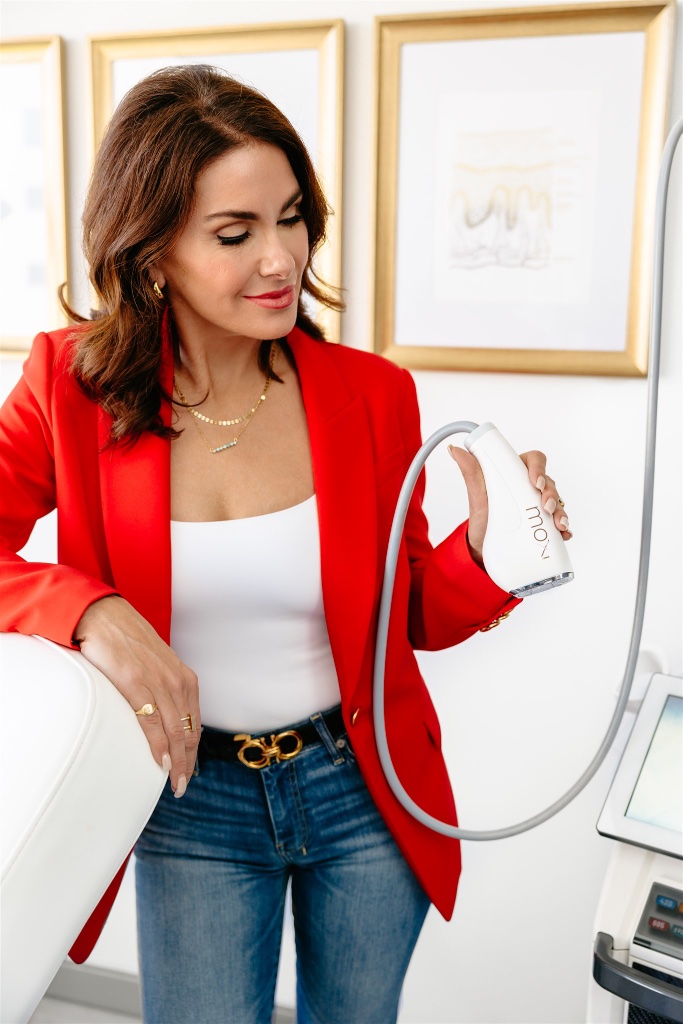
Written by
Amy Robbins, MSNA, APRN, CRNA, FNP-BC
A Quick Summary
This guide explains what a pore is, why each cause matters, why age changes the picture, what isn't actually a pore, and what may help.
Three main causes: oil output, loss of support around the pore opening, and follicle size.
What changes with age: mostly support. Collagen and elastic fibers weaken, especially with sun damage, so pores stretch.
What age doesn't do: oil output usually falls after 40, so oily skin alone doesn't explain bigger pores later in life.
Genetics and ethnicity influence pore size more than age does.
Pores can't be shrunk permanently, but sun protection, retinoids, oil and clog control, and collagen-remodeling treatments can improve how they look.
What a Pore Actually Is
Every pore on the face is the top of a hair follicle, usually a tiny, fine one. An oil (sebaceous) gland empties into it. The opening sits in the outer layers of skin and is held in shape by the collagen and elastic fibers around it, like the drawstring of a small bag. Pores don't open and close with heat or cold. What changes is how stretched, full or shadowed the opening looks.
The Three Main Causes
A widely cited dermatology review groups the causes of enlarged-looking pores into three.
Oil output
Oily skin tends to have more visible pores, especially on the nose, central forehead and chin. Oil output is driven largely by hormones — androgens in particular — which is why men usually produce more and why oil, and pore size with it, can shift across the menstrual cycle, rising around ovulation. A full, oily follicle has a wider, more visible opening.
Loss of support around the pore
The skin around each opening is held taut by collagen and elastic fibers. When that network weakens through intrinsic aging and, much more so, through years of sun exposure, the opening loses its tension and stretches. Studies link lower skin elasticity to larger pores. On the cheeks this shows up as pores that look elongated, oval or teardrop-shaped, sometimes lining up in rows. This is the cause that changes most with age. Our guide to what the collagen research actually says explains the collagen side.
Follicle size
Some people simply have larger follicles, and therefore larger pore openings, and that is mostly inherited. A large study of more than 2,500 women in five countries found that pore size and density varied far more with ethnicity than with age. Pores tend to appear around puberty, and in many groups their size changed relatively little after about 40.
Why Age Changes the Picture
If oil were the main driver, pores would shrink with age, because oil production generally declines after the 40s. They often don't, and the reason is support. As collagen and elastic fibers thin and fragment, particularly in sun-exposed skin, the follicle openings are held less firmly and the surrounding skin drapes slightly downward. That is why pores that were round and confined to the T-zone in your twenties can become larger and more oval across the cheeks in your forties and fifties.
Skin also renews more slowly with age. Dead cells linger on the surface, skin looks duller, and the shadow inside each pore stands out more. Our guide to why skin looks dull in winter covers that surface effect.
This also explains a common confusion. Tightening treatments aimed at sagging don't meaningfully change pore size. The loss of support that matters for pores is at the level of the skin around each opening, which is where resurfacing and collagen-remodeling treatments work. Our article on face tightening vs skin resurfacing explains the difference.
Other Things That Make Pores Look Bigger
- Clogging. A pore filled with oil and dead skin looks wider and darker. Sebaceous filaments — the grey or beige dots on the nose that refill within days of squeezing — are normal and not blackheads. Blackheads are true clogs whose tips have darkened in contact with air.
- Acne history. Repeated inflammation can damage the tissue around a follicle and leave it permanently wider. Some "large pores" are actually small, deep acne scars. See why adults get acne.
- Squeezing and picking. These stretch and inflame the opening, and repeated trauma can leave it larger.
- Dull or dehydrated skin. Pores stand out against a rough or dry surface and blend in against a smooth, hydrated one.
- Heavy or occlusive products. Some products settle into pores and emphasize them, and some can contribute to clogging.
- Lighting and magnification. Side light and magnifying mirrors exaggerate texture enormously. From conversational distance, most pores are far less visible than they look in a magnifying mirror.
Is It Really a Pore?
A few things are often mistaken for enlarged pores:
- Small, deep acne scars ("ice-pick" scars) look like large, sharp-edged pores but don't contain a follicle opening. They need scar treatment, not pore care; see acne scars vs post-acne marks.
- Sebaceous hyperplasia: small yellowish or skin-colored bumps with a central dip, common on the forehead and cheeks after middle age. They are benign, but a physician should confirm any new or changing bump.
- Milia: tiny white, hard bumps that are not open pores at all.
A Quick Self-Check
In daylight, without makeup:
- 1Where are they? Round, oily pores on the nose, chin and central forehead point to oil. Larger, oval pores on the cheeks point to loss of support.
- 2Is the skin shiny by midday? Then oil is a big factor.
- 3Are they filled or dark? Then clogging is contributing.
- 4Gently lift the cheek skin upward with a fingertip. If the cheek pores look noticeably smaller, stretching and support loss are part of the picture.
- 5Do some have sharp edges and no visible opening? They may be acne scars.
What Helps Prevent Pores From Getting More Noticeable
- Daily broad-spectrum sunscreen. Sun damage is the biggest controllable driver of support loss around pores.
- A retinoid, where tolerated. Retinoids help skin renewal and collagen, and one large controlled trial found more improvement in pore appearance with a prescription retinoid than with placebo.
- Gentle, consistent oil and clog control for oily skin, without over-stripping.
- Hands off. Don't squeeze or pick.
- Keep the surface smooth and hydrated.
What May Help: Matching the Pores to the Approach
The table pairs each pattern with the general category of approach that may be discussed, and what it cannot do. It is educational and does not recommend a treatment for any individual.
| What you notice | Likely driver | General approach categories that may be discussed | What that category does not address |
|---|---|---|---|
| Round, shiny pores in the T-zone | Oil output | Oil-control skincare (a retinoid, a salicylic acid product); a professional customized facial; a physician can discuss prescription options when acne is present | Pores stretched by support loss |
| Filled, dark or congested pores | Clogging | Regular gentle exfoliation; professional extractions; a peel such as BioRePeel | Follicle size; support loss |
| Oval or teardrop pores on the cheeks, with sun damage | Loss of support around the pore | Daily sunscreen and a retinoid, plus collagen-remodeling resurfacing such as HALO or MOXI, or microneedling; see best treatment for acne scars and large pores | Inherited follicle size; it does not shrink pores permanently |
| Sharp-edged "pores" that are really scars | Acne scarring | Scar-directed treatment such as ProFractional or microneedling, in a series | Oil-driven pores |
| Yellowish bumps with a central dip | Possible sebaceous hyperplasia | Physician evaluation | Not a pore concern |
| Pores look worse when skin is dull or dry | Surface roughness | Hydration, gentle exfoliation, skin-quality facials | Actual pore size |
For pores alongside wider texture change, see why skin texture changes with age.
What Treatments Cannot Do
- No treatment permanently shrinks pores or makes skin "poreless." Pores are normal structures. Treatments improve how visible they are.
- Results from resurfacing and microneedling are gradual, build over a series, and fade without sun protection and maintenance.
- Tightening treatments aimed at sagging don't meaningfully change pore size.
- Products marketed as "pore-shrinking" mostly work by temporarily tightening, mattifying or filling the surface.
- Inherited follicle size and pores that have been wide for decades improve least.
- Resurfacing in deeper skin tones carries a higher risk of pigment change, so candidacy and settings matter.
Common Myths About Pores
MYTH: Pores open with steam and close with cold water.
FACT: Pores don't have muscles. Heat softens their contents, and cold briefly tightens the surface, but the size doesn't change.
MYTH: Big pores mean oily skin.
FACT: Oil is one cause. In older skin, loss of support around the pore usually matters more, and oil production actually tends to fall.
MYTH: Squeezing out blackheads makes pores smaller.
FACT: It empties them briefly, and repeated squeezing can stretch and scar the opening.
MYTH: The grey dots on my nose are blackheads.
FACT: They are usually sebaceous filaments — a normal lining of oil that refills within days.
MYTH: The right product will shrink my pores for good.
FACT: Nothing shrinks pores permanently. Some treatments improve their appearance.
MYTH: Large pores mean my skin is unhealthy.
FACT: Pore size is largely inherited and varies widely between healthy people.
Consultations at Youthful Magnolia in Fort Worth
At Youthful Magnolia in Fort Worth, a consultation about pores starts with working out which kind you have — oil-driven, congested, stretched by support loss, inherited, or something that isn't a pore at all — and with sun protection and skincare before any device is discussed. When resurfacing or microneedling fits, we explain what improvement looks like, how many sessions it takes, and what it won't change.
If you'd like a clear read on your pores and what, if anything, would help, book a consultation. You can also read about HALO, microneedling, and the best treatment for acne scars and large pores.
Pores getting harder to ignore?
A consultation can sort oil from clogging and support loss, rule out things that aren't pores, and plan an approach that matches.
Frequently Asked Questions
References & Further Reading
Facial pores: definition, causes, and treatment options
Lee SJ, Seok J, Jeong SY, Park KY, Li K, Seo SJ. Dermatol Surg. 2016;42(3):277–285 · Peer-Reviewed Review
https://pubmed.ncbi.nlm.nih.gov/26918966/ ↗Facial skin pores: a multiethnic study
Flament F, Francois G, Qiu H, et al. Clin Cosmet Investig Dermatol. 2015;8:85–93 · Peer-Reviewed Study
https://www.dovepress.com/facial-skin-pores-a-multiethnic-study-peer-reviewed-fulltext-article-CCID ↗Enlarged facial pores: an update on treatments
Dong J, Lanoue J, Goldenberg G. Cutis. 2016;98(1):33–36 · Peer-Reviewed Review
https://mdedge.com/content/enlarged-facial-pores-update-treatments ↗This article is for educational purposes and does not provide a diagnosis or replace an individual medical evaluation.
Author
Amy Robbins, MSNA, APRN, CRNA, FNP-BC
Board-certified Family Nurse Practitioner and founder of Youthful Magnolia in Fort Worth, Texas.
Related Treatments
Get Started
Get a clear read on your pores.
Book a consultation at Youthful Magnolia in Fort Worth. We'll work out what is driving your pores, rule out things that aren't pores, and help you understand which available services, if any, may be appropriate for you.
Request a Consultation